
A Practitioner’s Guide to 6 Agentic GraphRAG Patterns
How autonomous agents turn static knowledge graphs into living Context Graphs that remember decisions, user intent, and operational history
Read original on Towards Data Science ↗

by ODEFTO Group

How autonomous agents turn static knowledge graphs into living Context Graphs that remember decisions, user intent, and operational history
Read original on Towards Data Science ↗
At Answer.AI, we built a tool that lets us learn, explore, and develop mastery with the help of AI. We call it SolveIt. As with everything we build, our goal was not to automate humans out of the process, but to help them grow. Over the past few years, it…
Read original on fast.ai ↗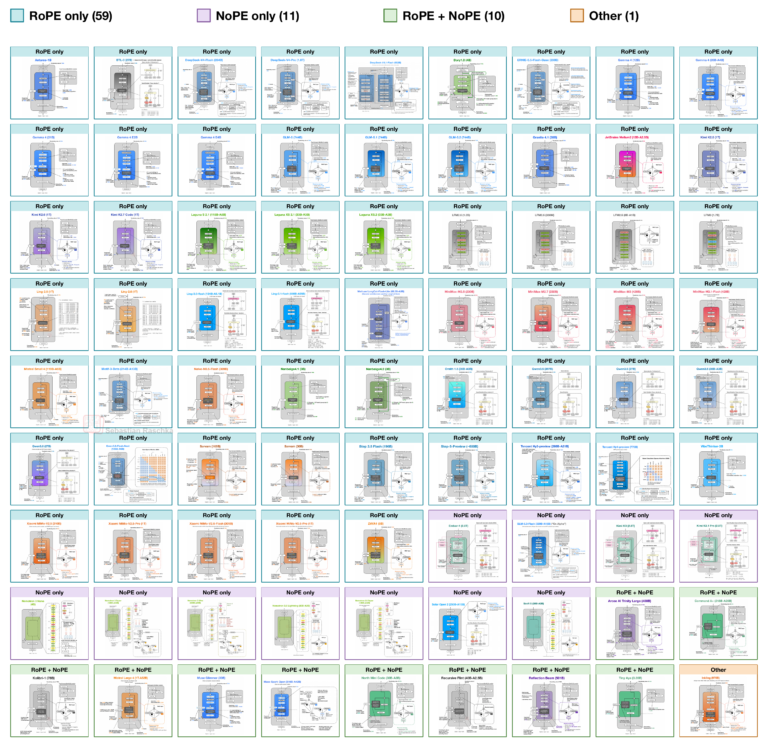
This article explains how LLMs encode and process token position information by covering classic and contemporary methods like RoPE. It’s essentially a comprehensive journey where we will work through the mechanisms with visual examples, a little math, and a small PyTorch implementation. And, of course, we will then also look…
Read original on Sebastian Raschka - Ahead of AI ↗
I usually can’t pinpoint the moment I stop using a software feature, with most tools drifting out of fashion without an expiration date. That’s not the case with YouTube Music’s “Beyond the Beat,” an AI-generated DJ that explains songs to you.
Read original on Wired - AI ↗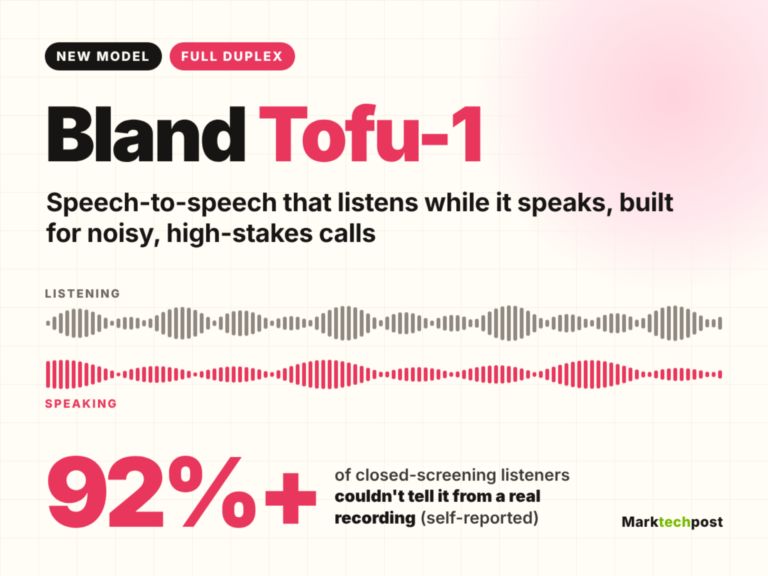
Bland, the San Francisco voice-AI company, has released Tofu-1, a full-duplex speech-to-speech model in research preview. The Tofu-1 speech-to-speech model targets calls from moving cars, hospital rooms and weak-signal lines. It listens while it speaks and reasons while it talks. For phone-agent teams, one model now handles audio in and…
Read original on MarkTechPost ↗
More than 300,000 people in the United States die from sudden cardiac arrest each year. This deadly emergency occurs when the heart's electrical system suddenly fails, causing the heart to stop pumping blood. It can strike older adults with known heart conditions as well as seemingly healthy young athletes. Although…
Read original on ScienceDaily - AI ↗
Outsiders had little reason to notice when Nvidia’s longtime chief security officer and head of product security stepped down in August. Just two and a half months later, CEO Jensen Huang himself left the company over growing questions about his extramarital relationships — starting with an executive at Megaspeed, a…
Read original on TechCrunch - AI ↗
datasette-llm is the intermediate plugin for Datasette that supports configuring LLMs for use with other Datasette plugins.
Read original on Simon Willison ↗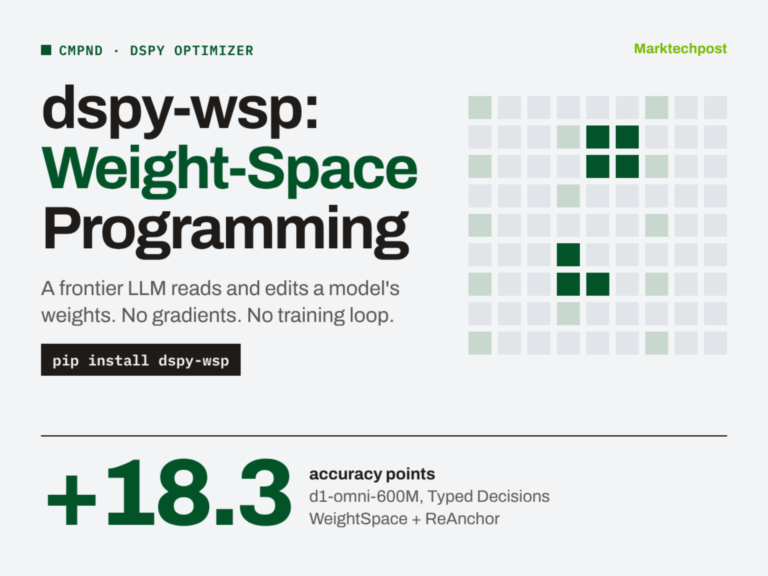
Cmpnd has released dspy-wsp, a prototype optimizer that brings weight-space programming to DSPy. Weight-space programming is a technique in which a frontier LLM reads another model’s weights and edits them directly. There are no gradients, no training loop and no fine-tuning dataset. dspy-wsp packages this as WeightSpace, an optimizer that…
Read original on MarkTechPost ↗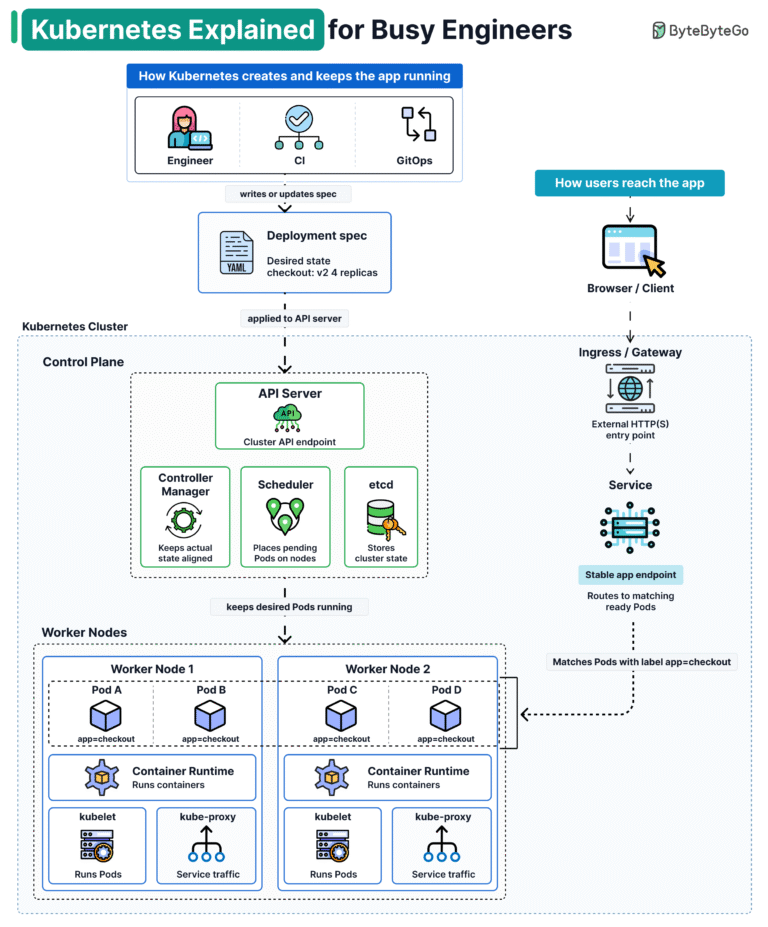
CJ Avilla from Anthropic sent his Claude Platform OpenTelemetry data to Sentry. It turned up an old project that was still burning tokens.
Read original on ByteByteGo (system design interviews) ↗
During autoregressive decoding, a transformer reads its weights for every new token. At small batch sizes, moving these weights can take more time than computation. Quantization reduces this cost by storing weights with fewer bits. For example, an INT8 weight uses half the raw storage of an FP16 or BF16…
Read original on Machine Learning Mastery ↗
A step-by-step guide to transition matrices, the Chapman–Kolmogorov equation, and stationary distributions, built around a three-state writing example.
Read original on Towards Data Science ↗
Today, I’m talking with Helen Toner, the executive director of the Center for Security and Emerging Technology at Georgetown University. This episode is part two of our series on AI in real life.
Read original on The Verge - AI ↗
With so much going on all the time, you may not have thought about ransomware and data extortion attacks in a minute, even though they’ve been among the the biggest cybersecurity threats to institutions—and, by extension, people—over the past decade. But in the new era of AI-powered and automated cyberattacks,…
Read original on Wired - AI ↗
The resignation of Nvidia CEO Jensen Huang is a major setback for the US development of an open model ecosystem. Nvidia still has the financial interests in supporting open models, which are to avoid concentration in power among a few customers who would develop their own chips and reduce Nvidia’s…
Read original on Interconnects ↗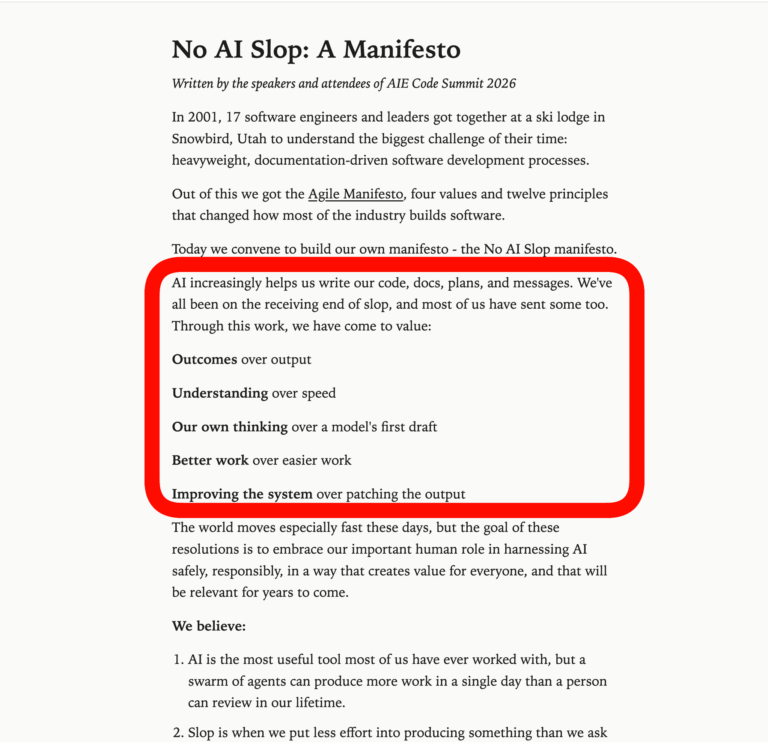
Congrats to both llama.ccp and ggml for reaching 1.0 (declaring stability and removing 35 deprecated functions from llama.cpp’s public header) and with SGLang also announcing 1.0 at the recent SGLang Summit. However, today’s title story goes to the No AI Slop manifesto, which arose out of the conference discussions at AIE…
Read original on Latent Space ↗
Recent HCI research leverages AI agents to assess graphical user interfaces (GUIs) usability, but current agents still struggle. Computer use agents (CUAs) that are used in these assessments are predominantly developed using objective task trajectories with verifiable outcomes and lack an operationalized definition of usability and necessary training data.
Read original on arXiv cs.AI ↗
Convolutional neural networks (CNNs) are widely used for time-series classification, but their deployment in critical contexts requires understanding the patterns across signal domains that drive their predictions (e.g., temporal or spectral). Concept extraction (CE) methods identify such patterns by analyzing representations within the models' latent space. However, existing time-series CE…
Read original on arXiv cs.AI ↗Enter your email to receive updates. You can unsubscribe at any time.



