Preloader

All AI News & Discussions

Understanding Private Evolution as Learning-Augmented Clustering
ResearchApple Machine Learning Research3 weeks ago

Understanding Private Evolution as Learning-Augmented Clustering

Private Evolution (PE) is a differentially private algorithm for synthetic data generation. While it can be viewed as a Wasserstein learning algorithm, it performs much better in practice than worst-case Wasserstein analyses would predict. We recast PE as generative model-augmented Wasserstein learning. We show theoretically that when we take into…

Read original on Apple Machine Learning Research ↗
Toward a Theory of Evaluability
ResearchApple Machine Learning Research3 weeks ago

Toward a Theory of Evaluability

Machine learning models, particularly large foundation models, are increasingly evaluated along multiple axes that are relevant for their usage. In addition to accuracy measures appropriate for the specific task of interest, measures capturing safety, calibration and fairness properties are often of interest. The classical approach to these problems assumes that…

Read original on Apple Machine Learning Research ↗
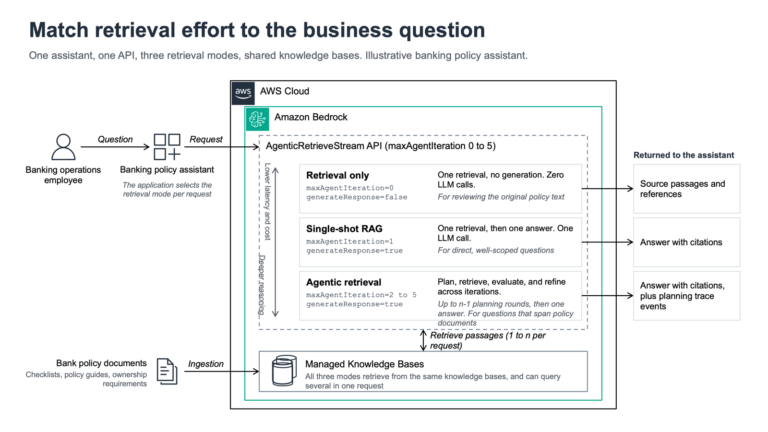
Single-shot and agentic retrieval with Amazon Bedrock Managed Knowledge Base
Tools & Open SourceAWS Machine Learning Blog3 weeks ago

Single-shot and agentic retrieval with Amazon Bedrock Managed Knowledge Base

A banking operations employee starts the morning by asking an internal AI assistant which documents are needed to open a business account. The answer is in a single checklist. A few hours later, the same employee asks how those requirements differ across sole proprietorships, LLCs, and partnerships with multiple owners.…

Read original on AWS Machine Learning Blog ↗
Attention Variants and Memory Efficiency
Concepts & ImplementationsMachine Learning Mastery3 weeks ago

Attention Variants and Memory Efficiency

Two transformer models with the same parameter count can have very different memory requirements during inference. A major reason is the structure of their attention layers. The number of key-value heads, the representation stored for each token, and the number of earlier tokens retained by each layer determine how much…

Read original on Machine Learning Mastery ↗