


“When we have learned how to listen to trees,” Hermann Hesse wrote in one of his least known, most beautiful essays, “then the brevity and the quickness and the childlike hastiness of our thoughts achieve an incomparable joy. Whoever has learned how to listen to trees no longer wants to be a tree. He wants to be nothing except what he is. That is home. That is happiness.”
To be ourselves is rooted in the recognition that, rather than a tree, a self is a forest; to be at home in the world is rooted in the recognition that a forest is a self. While indigenous cultures have known this since the dawn of knowledge, we are only just beginning to unlearn everything we have been taught by the erasure of our creaturely belonging that we call civilization in order to remember what we were born knowing: Life and its right are not something we can claim for ourselves unless we accord them to everything else that exists, bound to us by the mesh of mutuality that makes this drifting rock a living world.
In 2021, Ecuador led the way in this great unlearning by granting the Los Cedros Cloud Forest legal rights of personhood: the right to exist and flourish in the future.
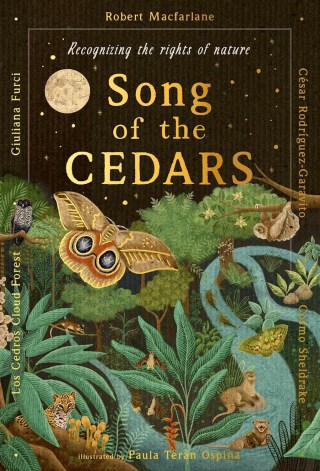
Five years later, four pioneers of the rippling rights-of-nature movement have joined forces with the forest itself to celebrate the landmark decision, as Copernican in the history of our civilization as the Cambridge Declaration of Consciousness: Robert Macfarlane (who has asked the urgent, self-answering question “Is a river alive?” and who remains the closest thing to a Rachel Carson of our time), Giuliana Furci (who has changed not only how we think about nature with her Fungi Foundation work but the very container of our thoughts, language, coining the word funga, now inducted into the Cambridge Dictionary, to stand alongside flora and fauna in our classification of the living world), César Rodríguez-Garavito (whose legal scholarship and activism have anchored the rights-of-nature movement), and Cosmo Sheldrake (who has devoted his life to turning the soundscapes of the living world into music). That they have named the Los Cedros Cloud Forest itself as co-author is both a radical gesture — a first in the history of literature — and a kind of homecoming to an elemental reality our sciences are only just beginning to confirm: that we think not with the brain but with the world, that place and personhood are indelibly entwined, that life is a song singing us back to ourselves so that when we die we may be sung across the threshold into the rhizomatic everythingness of everything.
Source: The Marginalian — Read the full article on the original site ↗