

The word of the year in the AI industry over 2026 has been “slop” — meaning low-quality output from a large language model. And with so much code being AI-generated now, avoiding slop has become a daily concern for software engineers. So how to do that? One way is to use formal verification systems, which use mathematical proofs and logic to verify the correctness of software or hardware.
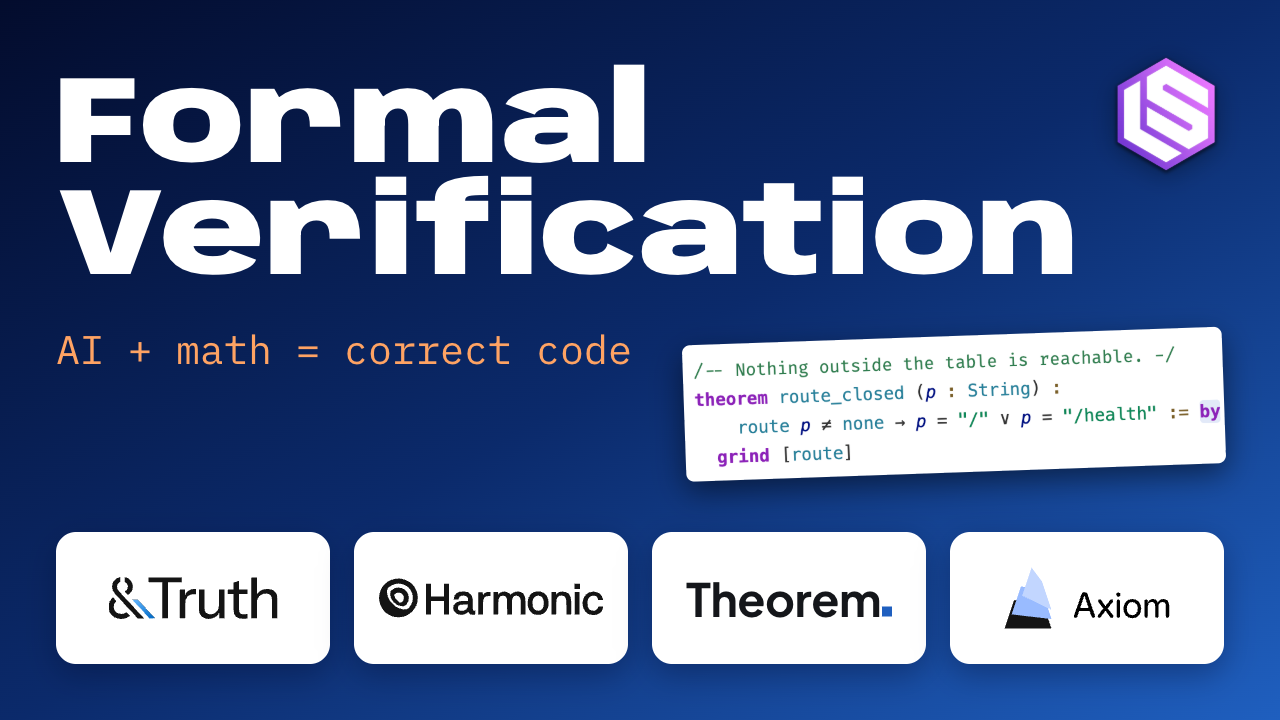
With AI’s growing prowess at solving math problems, there’s now a number of AI companies offering formal verification systems. They include Harmonic, Theorem, Axiom Math, and a new entrant called &Truth (pronounced ‘and truth’). In this article we’ll look at some of the approaches these companies are taking.
In order to better understand the landscape of formal verification systems, we spoke to one of its leading proponents: Clark Barrett, &Truth’s co-founder and co-CEO. He’s also Corbel Professor (Research) of Computer Science at Stanford and was the co-creator of cvc5, a popular automated reasoning engine used in formal verification.
Without getting too in the weeds, cvc5 is what’s called a “solver” for satisfiability modulo theories (SMT), which Barrett says is widely used in companies like Amazon. For instance, cvc5 is used for specification analysis and test generation in Kiro, Amazon’s agentic development environment.
Source: Latent Space — Read the full article on the original site ↗