Back on July 1, 2023, ESA’s Euclid space telescope launched.
This wide-field observatory is currently imaging and mapping out huge, 3D volumes of the Universe.
Alongside SPHEREx, Roman, and the ground-based Vera Rubin observatory, Euclid heralds a cosmological revolution.
Its two main science goals are to probe dark energy’s and dark matter’s properties.
It accomplishes this by mapping out enormous numbers of galaxies across 14,000 degrees of sky.
Galaxy clustering information, in 3D space, reveals how likely galaxies are to be separated by specific distances.
A key clustering distance scale — the acoustic scale — reveals dark matter’s properties.
Complementarily, weak lensing — apparent shape distortion by foreground masses — reveals how cosmic structure grows.
Via the growth of this structure, we can probe dark energy’s nature.
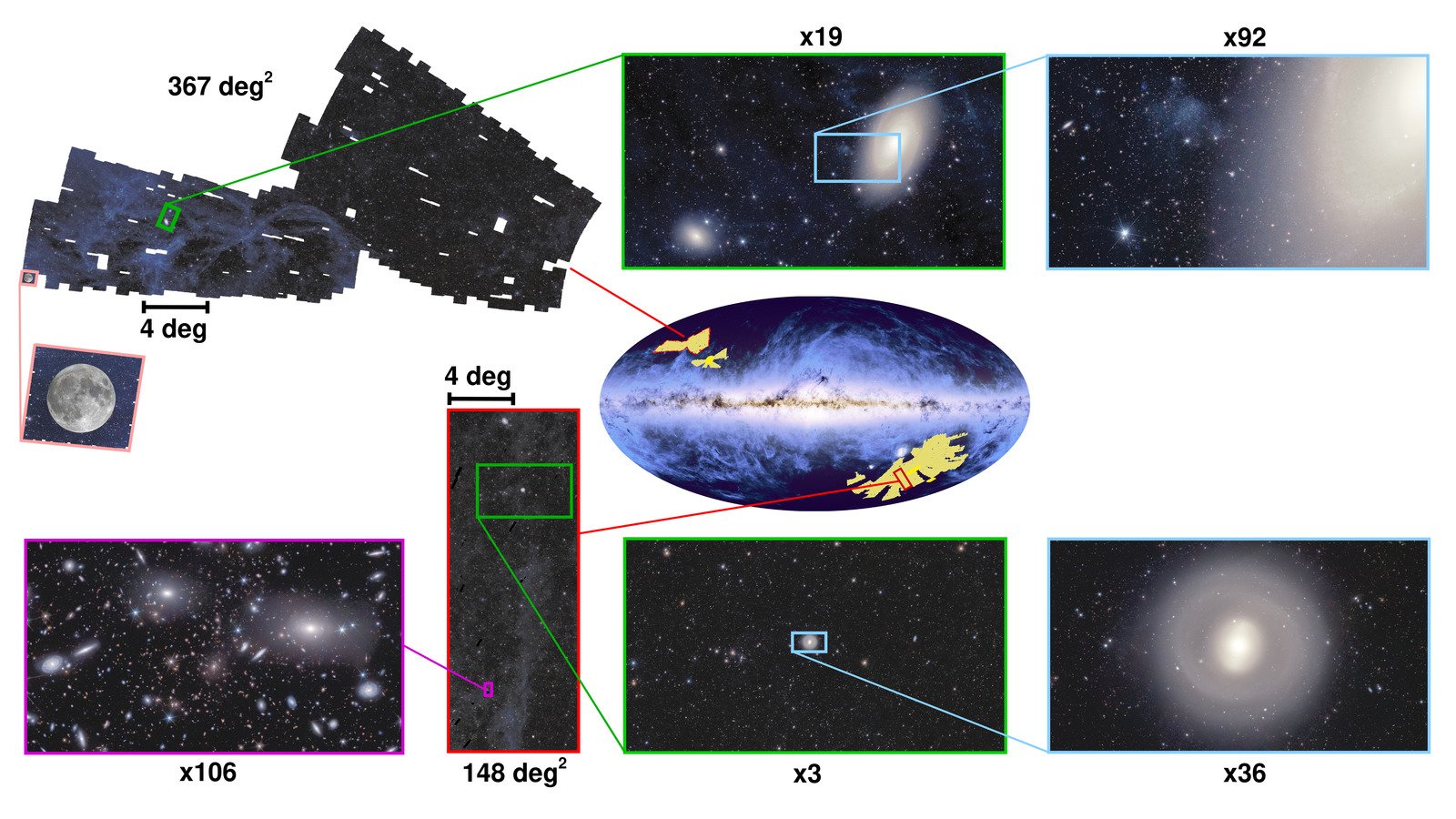
Euclid, covering 14,000 square degrees cumulatively, also yields a broad range of astronomical phenomena.
Spectroscopic capabilities pin down the redshifts of distant galaxies.
Strong lenses magnify background objects, particularly within rich galaxy clusters.
Some 15,000 galaxy-galaxy strong lens candidates also appear.
Superclusters abound: containing dozens of individual galaxy clusters apiece.
Rare objects, like ring galaxies, abundantly appear.
Additionally, novel, rare, faint features appear even in well-studied galaxies.
An ongoing website, EPOD, highlights Euclid’s picture of the day.
Mostly Mute Monday tells an astronomical story in images, visuals, and no more than 200 words.
This article Euclid’s newest release unveils a cosmic treasure trove is featured on Big Think.
Source: Big Think — Read the full article on the original site ↗
Get the best of this topic in your inbox
Join the newsletter. A short, useful digest, no spam.