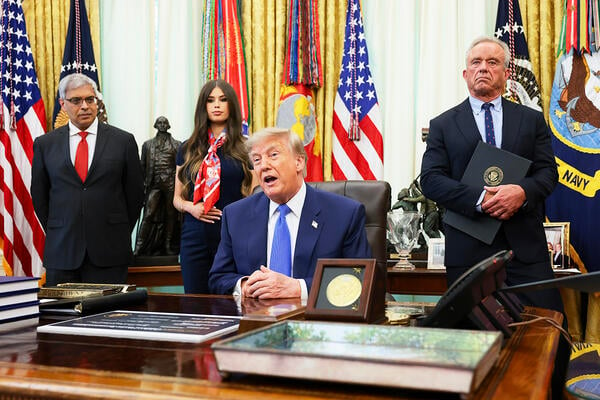
President Trump, NIH Director Jay Bhattacharya (left) and Health Secretary Robert F. Kennedy Jr. (right) have reshaped health and other research in ways beyond just cutting grants.
Since President Trump returned to the White House nearly two years ago, the higher ed and science communities have decried his administration for slashing or freezing billions of dollars for federal research, ordering mass layoffs at science funding agencies, canceling grants based on ideological objections and spurning international scholars.
But the administration hasn’t completely dismantled the nation’s research ecosystem—partly because Congress has repeatedly rejected Trump’s proposals to simply cut much of the budget for that ecosystem. Instead, the government has sought to reorder the whole system. Forced to continue funding agencies such as the National Institutes of Health and National Science Foundation, Trump officials have been using the money to shape their own vision of how scientific inquiry should function.
NIH has proposed reducing the role of peer review in choosing which grants to fund. The White House laid off the NSF’s oversight board. And in addition generally overhauling who decides which projects these agencies fund, the administration has shown the kinds of research projects it supports, from the Energy Department’s sweeping AI-focused Genesis Mission to NSF’s X-Labs project aimed at bolstering nonuniversity research and individual health studies focused on vaccine injuries, among other topics.
Federal agencies didn’t provide interviews for this article.
Most Popular
- The Invisible Labor of Women Leaders (opinion)
- How Will Trump’s New Rule Change Programmatic Accreditation?
- Faculty, Alumni Rally Against Pepperdine Faith Statement
The choices have unsettled some researchers.
“Less good science is a fear, and then the biggest fear is bad science,” said Nina Friedman, a former NIH intramural researcher and co-executive director of 27 UNIHTED, an advocacy group composed of current and former NIH employees.
Jeremy Berg, former director of the NIH’s National Institute of General Medical Sciences, said the administration continues to use “the credibility of the federal government’s scientific establishment to pursue some questions that leadership in the administration is interested in.”
Last month, Health Secretary Robert F. Kennedy Jr., NIH Director Jay Bhattacharya and John H. Powers III—who now leads the NIH institute that Anthony Fauci ran during the pandemic—announced a new study, which officials also often describe as a clinic, focusing on vaccine injuries and long-term symptoms after infection. NIH anticipates enrolling “several hundred patients initially,” the agency said in a news release.
Bhattacharya said in an announcement video that “we are opening a new vaccine injury clinic dedicated to developing the science of preventing vaccine injuries, making vaccines safer and—most important of all—listening to the voices of people who have suffered vaccine injury so that we can learn from them.”
Berg said the vaccine injury clinic is a relatively small initiative for NIH, “more or less in the noise” of its more than $47 billion annual budget. But the administration is using NIH resources to conduct “science, or pseudoscience,” in areas Kennedy is interested in, he said.
Friedman called the vaccine injury clinic “incredibly worrisome,” noting that while such injuries are real, they don’t seem to warrant a whole clinic.
In addition, The Wall Street Journal reported last year that the NIH was putting $500 million into research on vaccines that simultaneously protect against multiple virus strains—just as two researchers involved in studying such vaccines became NIH leaders. Friedman said, “That’s good science, but that’s not good science that needs that amount of money.”
The NIH is part of the larger Health and Human Services Department, which Kennedy heads. The department has been supporting research into issues that he and his former nonprofit, Children’s Health Defense, have claimed are health threats.
Editor's Picks
- Faculty, Alumni Rally Against Pepperdine’s New Faith Statement
- U of Kentucky Proposes Technology Policy Restricting All ‘Political Activity’
- International Student Enrollment Down 9% in Fall 2026
In September, HHS issued a request for information “calling on Americans, scientists, physicians, industry, and public health experts to submit evidence and information on the potential health effects of electromagnetic fields (EMFs), radiofrequency (RF) radiation, and wireless radiation exposure.” Among other things, the department is asking people to share their “experiences involving potential adverse health effects they believe may be associated with RF/EMF exposure,” seeking info on exposures from 5G, mobile phones and more.
“The MAHA [Make America Healthy Again] Strategy directed HHS to examine electromagnetic radiation and health research, and we are acting on that directive,” Kennedy said in a news release. He said he’s asking scientists and others to “bring us the best available evidence so we can identify the gaps and focus federal research where it is needed most.”
‘Violent’ Gender Ideology?
Since the beginning, the administration has targeted transgender individuals’ participation in sports and denied the existence of nonbinary people: The White House posted on X as recently as this month that “it is the official policy of the United States government that there are only two genders: male & female.”
Trump officials have also cut research related to transgender individuals, but not all of it: In August, HHS published a non-peer-reviewed study on “gender ideology” and “left-wing authoritarianism.” The authors—including a Rutgers University professor and a senior fellow at the conservative Manhattan Institute—wrote that scores on the “Clinical Gender Affirmation Scale,” which they developed, significantly predicted left-wing authoritarianism, and both the CGAS scores and left-wing authoritarianism “were also positively associated with justification of political violence across six targets: killing Charlie Kirk, killing Donald Trump, killing [UnitedHealthcare CEO] Brian Thompson, arson of ICE buildings, damaging wealthy people’s property, and violence against police.”
“These findings suggest that gender ideology is associated with LWA [left-wing authoritarianism] and willingness to justify political violence,” they wrote. “Experimental research is needed to determine causality.”
Last month, the Department of Justice’s National Institute of Justice published a notice of a grant competition in the area of “Research on Gender Dysphoria and Violent Crime.” The institute said it anticipates giving out $1 million for studies on, for example, “the relationship between violence and gender dysphoria diagnosis and/or treatment.”
These studies appear in line with the administration’s campaign against what it calls diversity, equity and inclusion. Trump officials have also cut grants to study disparities among racial and LGBTQ+ groups. At the same time, Trump signed an executive order last month establishing a Women’s Health Division at NIH—atop that agency’s existing Office of Research on Women’s Health.
“The division will advance research into conditions that uniquely or disproportionately affect women, strengthen accountability in federally funded research, and accelerate the translation of scientific discoveries into prevention, diagnosis, treatment, and clinical care,” HHS announced in a news release. The department added that this division will “increase inclusion of women and girls in clinical trials” and “reinforce NIH requirements to account for sex as a biological variable.”
Catharine Young, a senior fellow in Harvard University’s T. H. Chan School of Public Health and former White House Office of Science and Technology Policy assistant director during the Biden administration, noted on X that the NIH Office of Research on Women’s Health has existed since 1990. She also pointed out that Trump’s executive order creating the new division revoked two Biden executive actions aimed at advancing women’s health research.
“This announcement comes without specifying any NEW research funding commitment, which is what women’s health so desperately needs,” Young wrote. “I am absolutely supportive of a spotlight on women’s health but not another rebrand.”
The administration has targeted international research partnerships and international students and scholars in myriad ways, including by attempting to generally limit international students to four years in the U.S. and trying to charge $100,000 for each H-1B visa employee a university wants to hire. Courts have blocked both of those attempts so far.
Meanwhile, the administration announced a $100 million program last month for rising American scientists. Through the Genesis Mission Fellowship, students will “pursue accelerated four-year PhDs with dual competency in super [artificial] intelligence and another science or engineering discipline,” according to a White House fact sheet, which added that they’ll conduct research “embedded in industry and a DOE [Department of Energy] National Laboratory.”
Over the summer, White House Office of Science and Technology Policy Director Michael Kratsios and White House Office of Management and Budget Director Russell Vought released a report and related research and development priorities directing federal agencies to fund more research outside universities. That approach is reflected in NSF’s X-Labs initiative, which that agency has said “will scale a new generation of transformative independent research organizations to advance breakthrough science outside of traditional institutions.”
But an NSF spokesperson told Inside Higher Ed in an email that the X-Labs concept initially came from Congress during the Biden administration, stemming “from Congress’ charge in the CHIPS and Science Act, encouraging NSF to experiment with novel mechanisms to accelerate science and technology.”
In May, NSF announced it would devote $1.5 billion to X-Labs over the next decade. In its first round of funding opportunities, NSF said, it will underwrite research into developing quantum computing and new scientific instruments that draw on “quantum sensing” and AI. The spokesperson added that, in addition to the federal dollars, “the X-Labs Consortium’s founding partners represent more than $300 million in commitments, which include space, instruments and expertise from research institutions, computing centers, philanthropy and industry.”
“X-Labs are not a replacement for universities,” the spokesperson said. “NSF continues to invest in universities and their researchers across its programs, and research institutions are among the X-Labs Consortium’s founding partners.” He added that “university-anchored teams have been the majority of the applicants of the NSF X-Labs program thus far” and “NSF anticipates universities will represent a significant portion of the Phase 0 awardees.”
Democrats will take over Congress Jan. 3, and they’ve promised to increase oversight over Trump and federal agencies. Friedman, with 27 UNIHTED, says she’s “super hopeful” about that oversight, adding that “the tenor in the federal workforce has changed.”
“People are more than ready for a change,” she said.
Berg said he’s “cautiously optimistic.” Congress isn’t really moving from “an anti-science to a pro-science” position, he said; even under Republicans, “the president’s budgets for NSF and NIH were pretty much laughed out of Congress as not being serious documents.”
And Democrats’ oversight will mostly be requests for information rather than policy demands, Berg predicted.
“It’s not necessarily going to be a big panacea,” he said.
Source: Inside Higher Ed — Read the full article on the original site ↗
Get the best of this topic in your inbox
Join the newsletter. A short, useful digest, no spam.