Photo illustration by Justin Morrison/Inside Higher Ed | Jim Watson/AFP/Getty Images | Thomas Simonetti/The Washington Post/Getty Images
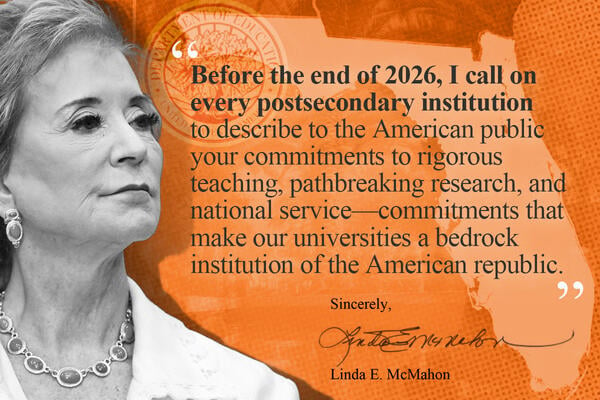
Florida’s independent colleges and universities may soon have to respond to the “Call to Action” Education Secretary Linda McMahon issued in August—whether they want to or not.
Members of Florida’s Commission for Independent Education voted Friday to advance a draft rule that would require private institutions under its authority to provide an “institutional transparency statement” as a condition of licensure. Florida Department of Education documents state that the proposed rule was inspired by McMahon’s letter and that institutions will have to submit details on admissions, academic rigor, affordability and more, as outlined in McMahon’s letter.
The commission is expected to consider the rule again in January. If adopted, it will then go to the Florida Board of Education for final approval. If approved, the rule will formalize a warning by Florida Commissioner of Education Henry Mack, who told private colleges in August the state would compel responses if they weren’t provided voluntarily. The proposed draft rule ultimately means if a college doesn’t respond, it could lose state licensure.
Most Popular
- The Invisible Labor of Women Leaders (opinion)
- How Will Trump’s New Rule Change Programmatic Accreditation?
- Faculty, Alumni Rally Against Pepperdine Faith Statement
An ‘Outrageous’ Proposal
Even as the commission advanced the rule, it faced pushback during the two-day meeting.
Allen Mortham, executive director of the Florida Association of Postsecondary Schools and Colleges, which represents more than 130 campuses, called the proposal “outrageous” during a public comment portion on the meeting’s first day. Mortham argued that institutions have not been given enough time to comply with McMahon’s Dec. 31 deadline, creating undue burdens, particularly for small colleges. He also noted that public institutions are not facing similar demands.
“We’re not asking for any kind of special treatment here in Florida. We’re not even asking for special treatment from the United States Department of Education,” Mortham told Inside Higher Ed in a Friday interview. “What we continue to ask is: Don’t require our schools to comply with additional rules, regulations, anything that makes it harder for us to educate the students of Florida that you’re not requiring public schools in the state university system and the state college system to have.”
Mortham also argued that some of the issues outlined in McMahon’s “Call to Action” letter aren’t applicable to career and technical schools, which are concentrated on topics such as cosmetology and welding. The commission is “trying to ram a square peg into a round hole,” he said.
Other private college representatives who spoke up during the meeting raised similar concerns about administrative burdens and additional regulation.
While the commission changed some of the proposed rule’s language in response to public comments, it left intact the state’s ability to strip licensure due to noncompliance. Still, commission officials cast the changes as a concession to those who voiced concerns.
“Institutions over the last two weeks have raised specific concerns about duplication, administrative burden, recurring certifications, and the degree of detail prescribed by the original proposal. Those concerns have produced substantial and identifiable revisions,” Commission General Counsel Eric Giunta said Friday as he shared changes made to the proposed rule.
They included removing a provision requiring annual certification and giving institutions more flexibility in responding to the letter, such as by allowing them to use previously published materials.
Editor's Picks
- Faculty, Alumni Rally Against Pepperdine’s New Faith Statement
- U of Kentucky Proposes Technology Policy Restricting All ‘Political Activity’
- International Student Enrollment Down 9% in Fall 2026
Though the draft rule passed unanimously on a 4-to-0 vote, some commissioners agreed with the feedback raised during public comment. Commissioner John Euliano acknowledged Friday that the draft rule will impose new regulations that will be difficult for small institutions to respond to and the additional requirement is “Exhibit A” for why the cost of higher education is increasing.
The Florida Department of Education did not respond to an emailed list of questions about the proposed draft rule, the pushback and the broader concerns raised during public comment.
The U.S. Department of Education did not answer questions about McMahon’s letter, such as how ED is tracking responses or whether it supports compliance mandates, but Ellen Keast, communications director for the under secretary of education, provided a statement.
“As Secretary McMahon stated, the Department is urging universities to restore their foundational commitments to academic excellence, pathbreaking research, and national service. It’s no surprise that public confidence in higher education is at an all-time low: tuition is out of control, admissions processes are opaque, and too many colleges have abandoned free inquiry and viewpoint diversity,” she wrote. “We are encouraged that prominent institutional leaders have welcomed this call for bold reforms. The changes urged in the letter will go a long way toward restoring public confidence in higher education and strengthening the federal partnership.”
Broader Concerns
Florida was the first state in the nation to respond to McMahon’s “Call to Action”: All 40 of its public institutions signed on to a shared statement in August, shortly after McMahon’s letter came out. An Inside Higher Ed analysis found that more than two dozen of Florida’s private colleges and career schools have also responded independently, including institutions the letter was likely never intended to target, such as the Interstate Commercial Driving School and the Beauty Massage Institute.
Some critics view the proposed mandate as government overreach.
Amy Reid, director of the free speech group PEN America’s Freedom to Learn program (and a former New College of Florida professor), told Inside Higher Ed by email the proposal expands “state efforts to exert ideological control over all of post-secondary education” and would “force schools to publicly align with a position advanced by the state and federal government.”
Reid—who left New College in 2025 amid a conservative overhaul of the institution driven by Republican Gov. Ron DeSantis and his allies—argued that “Florida has sadly been at the forefront of efforts to censor higher education” and she is “concerned about the implications for free expression, academic freedom, and institutional autonomy” for colleges there.
“This is about expanding the years-long effort led by the DeSantis administration to exert control over what is taught, studied, and researched on college and university campuses in Florida, and given the timing of this move, on the heels of the mid-term elections, it seems like this is about making a statement for a national audience, as well as for the state,” Reid wrote.
Source: Inside Higher Ed — Read the full article on the original site ↗
Get the best of this topic in your inbox
Join the newsletter. A short, useful digest, no spam.