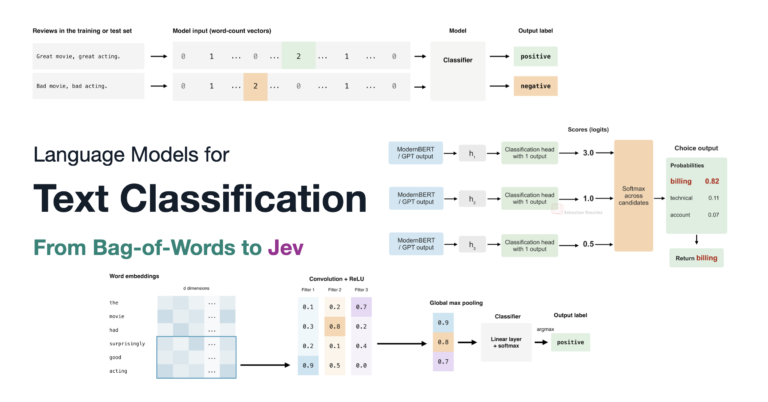
Language Models for Text Classification: From Bag-of-Words to Jev
The recently released Jev AI model has been quite a cultural phenomenon in technical communities in the past 2 weeks.
Read original on Sebastian Raschka - Ahead of AI ↗

by ODEFTO Group

The recently released Jev AI model has been quite a cultural phenomenon in technical communities in the past 2 weeks.
Read original on Sebastian Raschka - Ahead of AI ↗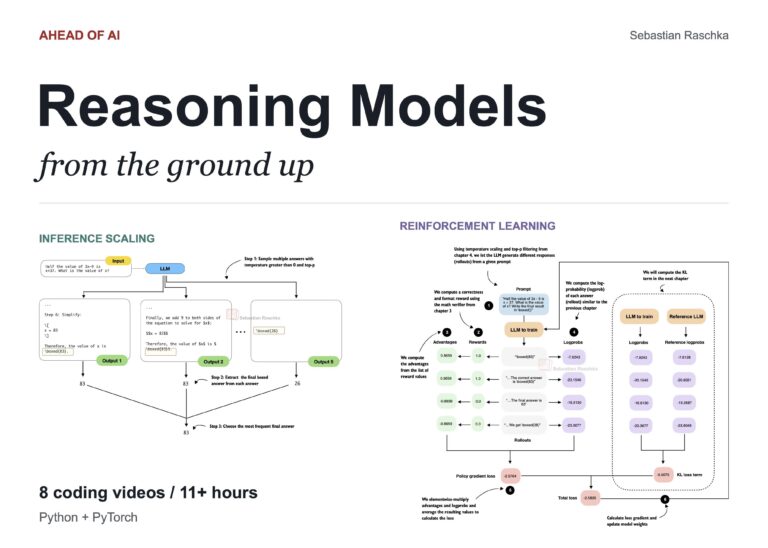
I have written a lot about reasoning models here over the last two years on Ahead of AI, including a recent article on mechanisms to control reasoning effort levels in contemporary LLMs. Reasoning models are still as relevant as ever. In fact, almost all current-generation LLMs today are reasoning models or offer a reasoning mode.
Read original on Sebastian Raschka - Ahead of AI ↗
In this article, you will learn how to turn an open-weight language model into a decision model that classifies user intent, by fine-tuning Qwen3.5-4B on the CLINC150 dataset with Unsloth.
Read original on Machine Learning Mastery ↗
In this article, you will learn how Python decorators work under the hood and how to build reliable ones for timing, retries, caching, and input validation.
Read original on Machine Learning Mastery ↗
From November 5 to November 20, 2026 (starting at 8:00 a.m. UTC), 365 Data Science will grant free access to its entire learning platform. This limited-time opportunity allows aspiring AI professionals and data enthusiasts to enhance their skills and gain practical, hands-on experience, completely free of charge.
Read original on Machine Learning Mastery ↗
In this article, you will learn what DiffusionGemma is, how its diffusion-based text generation differs from standard autoregressive language models, and how to run it with Hugging Face Transformers and vLLM.
Read original on Machine Learning Mastery ↗
A model is a collection of numbers. The format used to store and compute with those numbers affects how much memory the model occupies, how quickly the hardware can move the numbers, and which arithmetic units can process them. Changing precision can therefore make inference faster without changing the model architecture.
Read original on Machine Learning Mastery ↗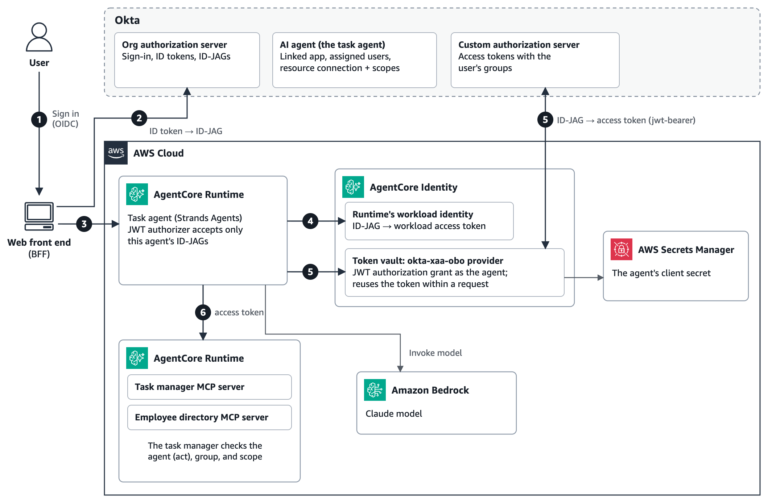
An AI agent that updates a ticket or reads a customer record acts for a person, inside applications that person can reach. Your identity team then has to answer a question that per-app OAuth consent and shared service accounts leave open: which agent might act for which user in which application, and how you stop it. Okta Cross App Access (XAA) answers it in your identity provider (IdP). You register the agent in Okta, an administrator approves the applications it might reach, and Okta evaluates policy each time the agent asks to act for a user. In our tests, after an administrator removed a user’s assignment to the agent, Okta refused the agent’s new requests for that user within about…
Read original on AWS Machine Learning Blog ↗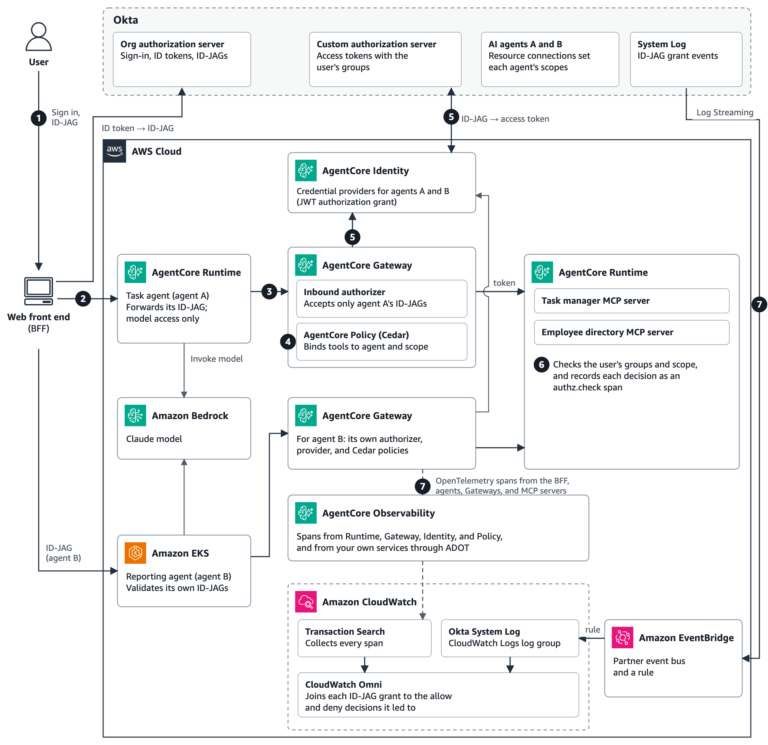
In Part 1, you built a task agent on Amazon Bedrock AgentCore, a platform to build, connect, and optimize agents at scale, with any framework or model. The agent runs on Amazon Bedrock AgentCore runtime, a capability of Amazon Bedrock AgentCore, and acts for signed-in users through Okta Cross App Access (XAA). Okta decided which agent might act for which user, and Amazon Bedrock AgentCore Identity, a capability of Amazon Bedrock AgentCore, redeemed Okta’s grant inside the agent. That proves the governance mechanism, and it runs on a deliberately small topology: one agent, two Model Context Protocol (MCP) servers, and the authorization check written into each server.
Read original on AWS Machine Learning Blog ↗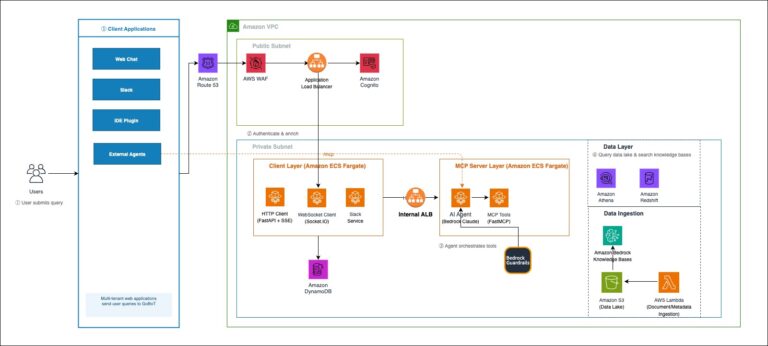
Organizations building applications powered by artificial intelligence (AI) face a recurring challenge: giving large language model (LLM) agents access to enterprise data lakes without duplicating integration logic across every agent and application. Most teams begin by wiring agents directly to databases and APIs, with no shared gateway such as a Model Context Protocol (MCP) server in between. Each new dataset demands custom code, and each agent reimplements its own access control. As the number of datasets or agents grows, permission enforcement drifts, and onboarding a new data source becomes a multi-day engineering effort.
Read original on AWS Machine Learning Blog ↗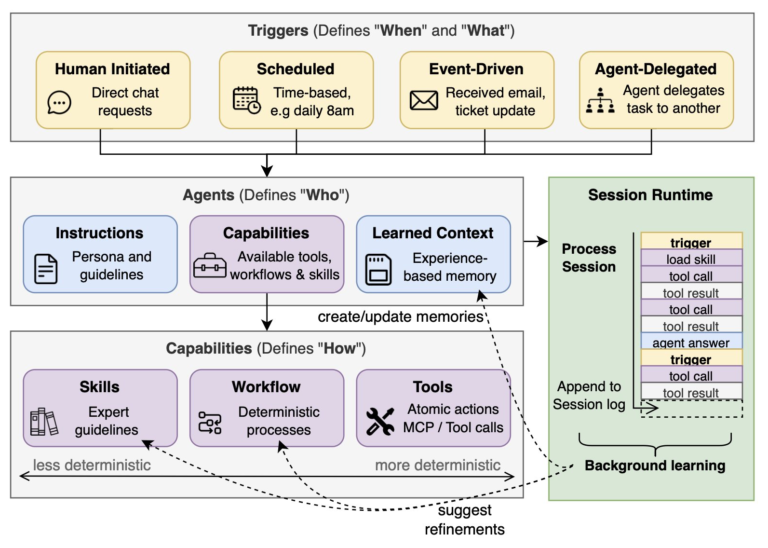
Over the past year, as we built Amazon Quick, our agents went from answering questions to taking actions: scheduling meetings, running research, generating reports. As the system evolved, one problem kept resurfacing: there was no shared definition of the primitives that agentic work is built from. The same few ideas kept getting rebuilt under different names: an actor that does the work, a signal that starts it, a packaged procedure, and a memory that carries lessons forward. This repetition leaked into product design and onto the user.
Read original on AWS Machine Learning Blog ↗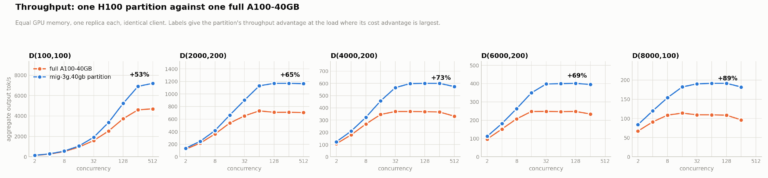
When you deploy a model to a GPU endpoint, the smallest unit of GPU you can request is one whole accelerator.
Read original on AWS Machine Learning Blog ↗
As GPU clusters scale, operations span compute, network, hardware, and scheduling. Site reliability engineers (SREs) often have to examine multiple dashboards to identify the cause of training performance drops. What if a team of AI agents could perform that correlation through one interface?
Read original on NVIDIA Technical Blog ↗
In an AI factory, high bandwidth memory (HBM)is the fastest, most expensive, and most contested memory tier. Every byte spent on a redundant weight copy, an idle session’s KV cache, or a recomputed prefix is a byte that is not being used to produce tokens. The question is no longer how much memory a GPU has, but how much useful work each byte delivers.
Read original on NVIDIA Technical Blog ↗
One underperforming GPU can slow an entire distributed training job. The node may pass basic health checks and show normal utilization, leaving operators to discover the problem only after the workload is running.
Read original on NVIDIA Technical Blog ↗
During reinforcement learning (RL) post-training, training trajectories are generated on the fly by running inference with the current policy model. For training efficiency, it is common to run inference and training in parallel on separate GPU resources in a disaggregated setup. Although the policy model is updated only on the training GPUs, the system must periodically refresh the weights on the inference GPUs with the latest parameters generated on the training GPUs. This transfer of model weights between training and inference GPUs is called refit.
Read original on NVIDIA Technical Blog ↗
When deploying diffusion models in design tools, image editors, and visual production workflows, developers must account for inference latency. Generating an image requires multiple sequential passes through a model with billions of parameters, and higher resolutions increase attention costs.
Read original on NVIDIA Technical Blog ↗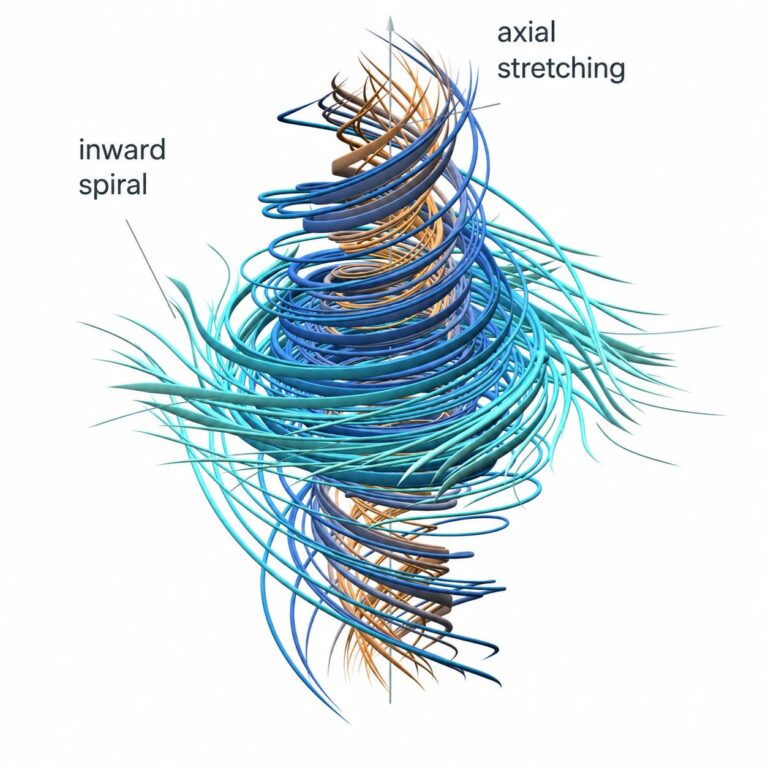
OpenAI fought dirty on career-making math problem, says NYU mathematician
Read original on Last Week in AI ↗Enter your email to receive updates. You can unsubscribe at any time.



